
Svalbard Crossing - 8 Day Ski Expedition from East to West
The extended route of the classic Svalbard ski crossing
Over eight days, we cover approximately 120 km on skis, travelling from the remote east coast of Spitsbergen all the way back to Longyearbyen.
Instead of rushing across Svalbard in four days, this expedition gives us eight full days to travel through the wilderness. The extra time gives us greater flexibility to adapt to weather conditions, take scenic detours when conditions allow, and follow a longer route all the way back to Longyearbyen. On an Arctic expedition, flexibility is key to success.
We begin on the east coast of Spitsbergen and gradually make our way west. While most of Svalbard’s settlements and human activity are found on the west coast, the east is dominated by glaciers, wide valleys and a true sense of remoteness. April offers long daylight hours with the return of the midnight sun, while temperatures are generally more manageable than earlier in the season.
This expedition takes us through some of Svalbard’s most characteristic landscapes. Travelling on skis allows us to experience the terrain at a more immersive pace, as the scenery gradually changes day by day. We move through broad glacial valleys shaped by previous ice ages, with snow-covered mountains surrounding us in every direction.
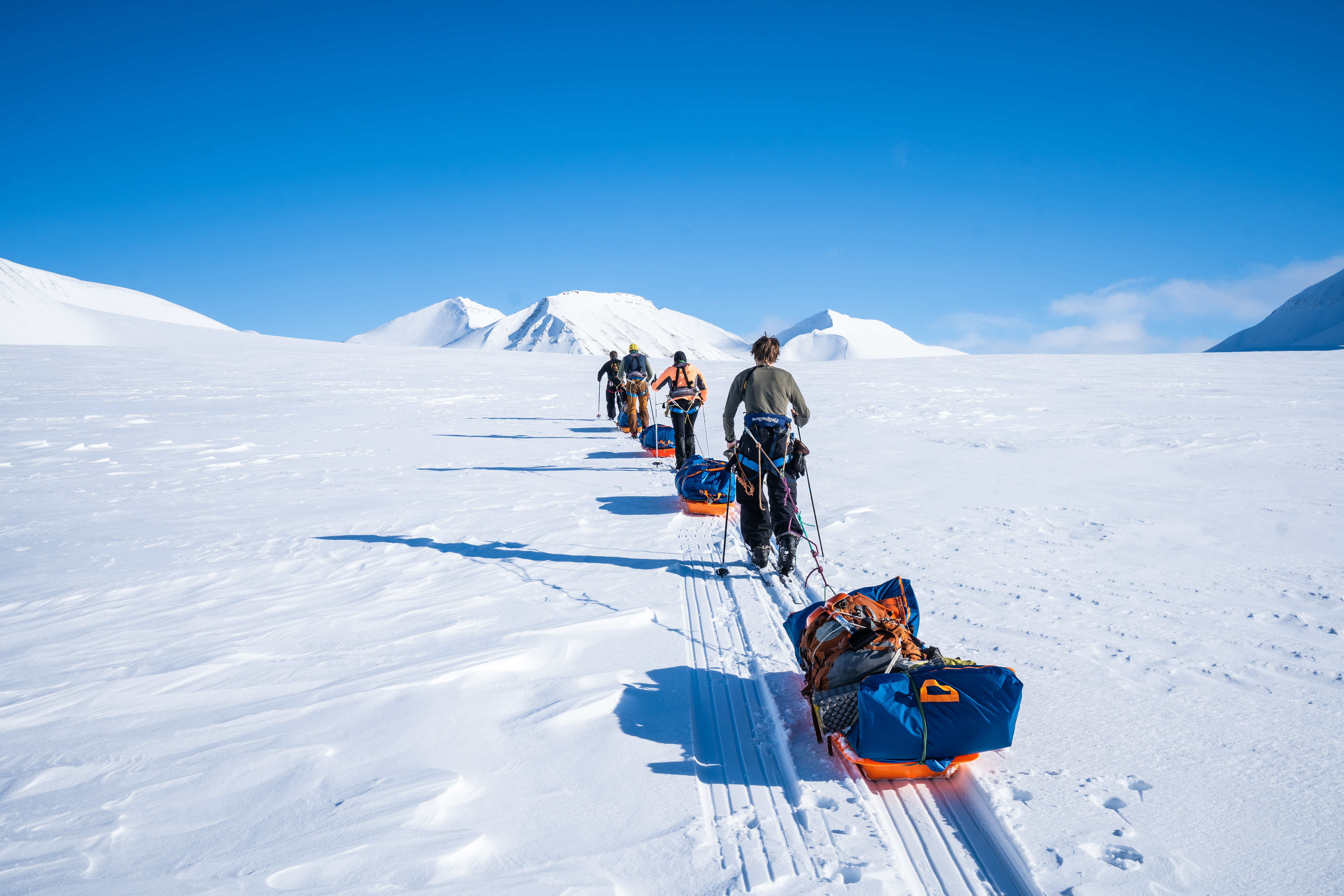
We navigate with map and compass, sleep in tents in the snow, and pull our expedition sleds behind us with all our gear. During the eight days on skis, we cover approximately 120 km, with daily distances varying depending on terrain, weather and the pace of the group. Most days are between 15 and 20 km.
In the evenings we work together on the daily camp tasks, prepare dinner, and enjoy the quiet surroundings that we will find out there. During the night we take turns on polar bear watch, an essential part of travelling through the Arctic wilderness and an experience that will stay with you long after the expedition is over.
Day 1 – Preparations and Packing
Today you will meet the group and your guide. We take the time to go through the equipment, pack our expedition sleds, check the weather forecast and review the route for the coming days. There is also time to visit one of the outdoor shops in town in case you have forgotten anything. If you are renting skis in town, make sure to collect them as well.
Accommodation is not included on this day. For a cosy guesthouse, you can check out Guesthouse 102. We recommend arriving 1–2 days before the expedition starts, which gives you some extra time in case of flight delays, lost luggage, or other unexpected changes. It is also a nice opportunity to relax and settle in before heading out into the wilderness. If you are looking for suggestions on what to do here for a few days, we are happy to share our recommendations.
Day 2 – Expedition Start
Today the expedition begins. We meet in the morning and load our pulkas and gear before a belt wagon transports us out to the starting point of the expedition. The drive to the east coast takes roughly six hours.
Once we are dropped off in Agardhbukta, around 70 kilometres from Longyearbyen and the nearest road, we are on our own. We attach our pulkas, clip into our skis and begin the crossing. Our goal for the day is to reach Passbreen Glacier, where we set up our first camp and take our first rotation of polar bear watch during the night.
Approx. distance: 8 km
Day 3 – Passbreen to Kjellstrømdalen
We wake up on the glacier and start the day with breakfast and coffee before getting ready for our first full day on skis. The first stretch in the morning takes us across the glacier with approximately 300 metres of elevation gain. After lunch, we leave the glacier behind and descend into Kjellstrømdalen.
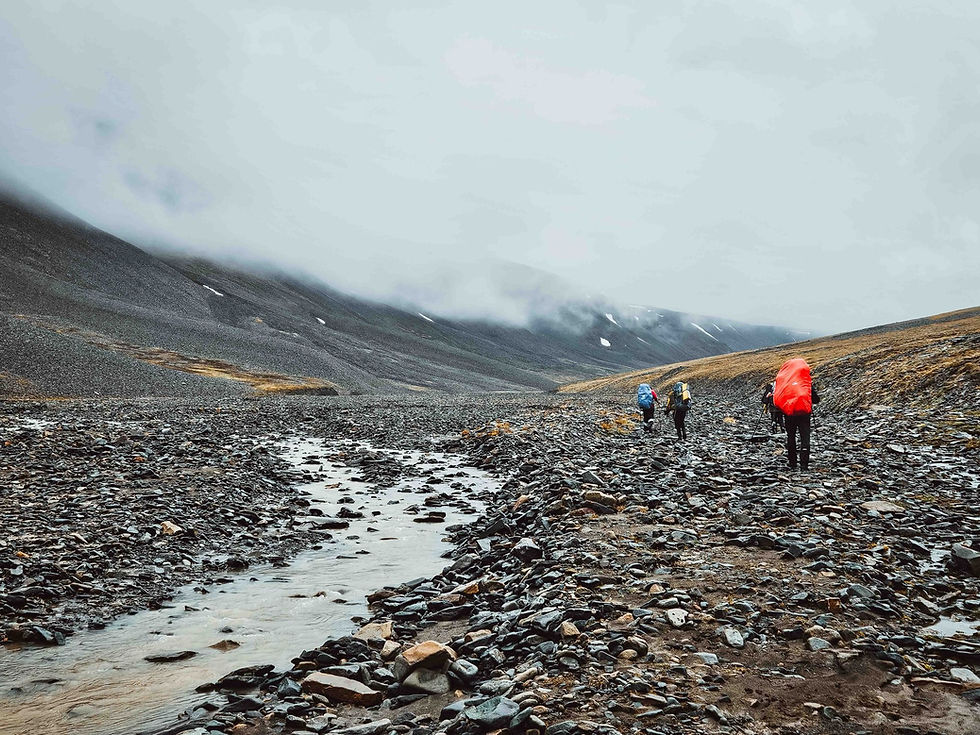
This is our first wide valley of the crossing, a landscape which is very typical of Svalbard. In this valley we also find unique geological features such as pingos. We continue through the valley for another few kilometres before turning inland and leaving the coast further behind.
Approx. distance: 18 km
Day 4 – Through Lundstrømdalen
Lundstrømdalen is a bit narrower, north–south facing valley where steep mountains rise on both sides. This is also a snowmobile-free area, allowing us to truly enjoy the peace and quiet of the Arctic. The terrain is flat today as we follow the frozen riverbed through the valley, slowly making our way towards the next opening in the landscape.
Eventually, we will turn west into Reindalen, a valley so vast that we will spend the next few days here.
Approx. distance: 18 km
Day 5 – Into Reindalen
Today we continue deeper into Reindalen, one of the biggest valleys of the island. We will establish three camps in this valley as we gradually make our way westwards towards the coast.
At its widest, Reindalen stretches seven kilometres across, creating an impressive sense of space and remoteness. With wide open terrain, distant mountain ranges and very few signs of human presence, this valley gives a true feeling of wilderness.
Approx. distance: 12 km
Day 6 – Reindalen to Semmeldalen
The area is also home to several Arctic species, including Svalbard reindeer, ptarmigan and Arctic fox, so we keep our eyes open as we move through the landscape.
Today we also pass the halfway point of the expedition. By now, you know your camp routines, your body is adapting to the rhythm of expedition life, and pulling your pulka feels easier as the days go by.
Approx. distance: 19 km
Day 7 – Semmeldalen to Skiferdalen
Today we finally leave Reindalen behind and turn north into Semmeldalen. We move away from the coastline once again, reducing the likelihood of encountering polar bears along the coast.
We know that for many visitors, seeing a polar bear in its natural habitat is a dream. However, on an expedition like this, we prefer to have them far away when we travel through their habitat. If polar bears are present in the area, we may need to adjust our route accordingly.
Tonight we plan to camp in Skiferdalen.
Approx. distance: 15 km
Day 8 – Skiferdalen to Endalen
We continue from Skiferdalen through Colesdalen and towards Fardalen. To the west, glimpses of Isfjorden remind us that civilisation is slowly drawing closer. Now, only one mountain range separates us from Longyearbyen.
Tonight we establish our final camp at the foot of Bingtoppen. Surrounded by the mountains, we enjoy one last evening in the silence of the Arctic wilderness before completing the final stretch back to Longyearbyen tomorrow.
Approx. distance: 20 km
Day 9 – Final Leg to Longyearbyen
The final day of the expedition has arrived. As we make our way towards Longyearbyen, signs of human activity gradually begin to appear in the landscape. The old mining structures and characteristic cableway towers bear witness to Longyearbyen’s history and tell us that the town is close.
You may be looking forward to a hot shower and a good meal back in town. After skiing 120 km across Svalbard, you’ve certainly earned it.
Approx. distance: 10 km
Trip Overview
- Difficulty level: 5 out of 5
- Participants: 4–12
- Next departure: 19th - 27th of April 2027
- Duration: 1 + 8 days
- Age limit: 18 years
Why This Expedition?
There are several ways to cross Svalbard, but this route is designed to give us a more extensive wilderness experience. Rather than completing the crossing in four days, we spend eight days travelling through the landscape, allowing us to explore valleys and areas that are often missed on shorter crossings.
With only a single beltwagon transfer at the beginning of the expedition, we maximise our time on skis and minimise the need for motorised transport. This allows us to travel through Svalbard's wilderness with a lighter footprint.
Who is this trip for?
This expedition is suitable for people in good physical shape who are comfortable skiing 10–20 km per day for eight consecutive days. You should have some previous skiing experience, but you don't need previous expedition experience. Each participant pulls their own expedition sled (pulka), weighing approximately 30–40 kg. Before the trip, you will receive a detailed packing list to help you prepare. We also recommend you start exercising beforehand, to make the experience more enjoyable.
You should be comfortable spending several nights camping on snow and prepared for potentially cold Arctic conditions. Expedition life is a team effort, and everyone takes part in daily camp tasks such as pitching tents, cooking, melting snow for water, and taking turns on polar bear watch during the night. You should enjoy sharing the adventure with a small group of like-minded people. If you are a group of five or more, please send us an e-mail to inquire about a private offer.
What can you expect?
As with all expeditions in Svalbard, the weather plays an important role. Conditions can change quickly, and strong winds, snowfall, and whiteout conditions are all part of travelling in the High Arctic - just as much as calm days under the midnight sun. Our guides continuously assess the conditions and adapt the route when necessary to ensure a safe and enjoyable journey. Temperatures in April can vary greatly, from around -20°C to above freezing. You may experience everything from sunny spring days to full Arctic snowstorms, making it essential to bring the right equipment.
This is a self-supported expedition, meaning we carry everything we need with us. As we move each day, we set up camp in a new location each evening. Together, we build our camp, prepare snow toilets, and create a shared area where the group can relax and enjoy meals. Dinner will be a mix of home-cooked dishes and lightweight freeze-dried expedition meals to keep the weight in the pulka low. If you have any dietary requirements, we can accommodate most, but please do contact us.
The stated distances for each day are approximate. We may do shorter or longer stretches depending on weather conditions and the pace of the group. There are no established trails in this area, so for much of the trip we will be making our own tracks.
During the night we will do shifts on polar bear watch. Note that it doesn't get dark anymore due to the midnight sun. Every participant is expected to take part, and your guide will explain the procedures and responsibilities. It is a unique part of the expedition and often remembered by guests as one of the most special experiences of the trip.
Included in the trip
- Round-trip transport between your accommodation and our expedition base
- Beltwagon transport between Longyearbyen and the expedition start point
- Expedition sled (pulka), harness, and pulling system
- Breakfast, lunch, dinner, and snacks throughout the expedition
- Tent, sleeping mat, stove, cooking equipment, and other shared group equipment
- Experienced guide(s) with necessary safety equipment, including polar bear protection, and emergency communication.
- Depending on group size, the expedition will be led by one or two guides
- Search and rescue (SAR) insurance
What you need to bring
- Backcountry skis (fjellski) with steel edges, for example Salomon or Åsnes. Randonnée/alpine touring skis are not accepted
- Ski equipment including warm ski boots, poles, short and long skins
- Warm clothing suitable for Arctic conditions
- Sleeping bag*
N.B. You need to bring your own ski equipment. If you purchase new gear, make sure to test it well in advance to ensure a good fit and avoid blisters. Ski equipment can also be rented from a local sports shop in Longyearbyen, but this must be arranged well in advance.
* Sleeping bags and liners can be rented for NOK 600.
A detailed packing list will be sent to you after your booking is confirmed.
Larger luggage can be stored at our warehouse during the expedition.
Disclaimer
The itinerary may change depending on weather, snow conditions, polar bears and the progress of the group. If polar bears are present in the area, we may adjust the route or return to Longyearbyen and continue with alternative day activities. Safety for both people and wildlife is always our highest priority.
A minimum of four participants is required for the expedition to go ahead.
© Photos: August T. Gautun